NLP with Python

Sentiment analysis in Python using NLP to detect positive, negative, and neutral emotions in text data

Sentiment Analysis in Python: A Beginner’s Guide to Analyzing Text Emotions with NLP (2026)

1. Introduction Sentiment Analysis in Python is one of the most powerful techniques in Natural Language Processing (NLP) used to automatically identify emotions, opinions, and attitudes in text data. Imagine waking up one morning to discover that a single negative tweet about your brand had gone viral overnight, sending your company’s stock price plummeting by […]

Sentiment Analysis in Python: A Beginner’s Guide to Analyzing Text Emotions with NLP (2026) Read More »

Text Classification in Python illustration showing NLP model categorizing text into labels like billing, tech support, shipping, and account using machine learning.

Text Classification in Python: Build Your First Powerful NLP Classifier Step-by-Step (2026)

Introduction: Why Text Classification Matters in 2026 Text classification in Python is one of the most important techniques in modern Natural Language Processing (NLP). It allows developers to automatically categorize large volumes of text such as customer support messages, product reviews, emails, and social media posts. As the amount of digital text continues to grow,

Text Classification in Python: Build Your First Powerful NLP Classifier Step-by-Step (2026) Read More »

Word Embeddings in Python infographic showing Word2Vec and GloVe vector relationships with example king minus man plus woman equals queen in NLP

Word Embeddings in Python: A Beginner’s Guide to Word2Vec and GloVe for NLP (2026)

1. Introduction: From Text to Math Computers are powerful at processing numbers, but they cannot directly understand human language. When we read a sentence, we automatically recognize the meaning of words, their relationships, and the context in which they appear. Machines, however, only understand numbers. This is where Word Embeddings in Python become essential in

Word Embeddings in Python: A Beginner’s Guide to Word2Vec and GloVe for NLP (2026) Read More »

TF-IDF in Python example showing how text documents are converted into numerical vectors for NLP using term frequency and inverse document frequency

TF-IDF in Python for NLP: A Beginner’s Step-by-Step Guide to Converting Text into Numbers (2026)

Introduction Natural Language Processing (NLP) systems cannot understand text the same way humans do. Humans easily understand sentences, context, and meaning, but computers require numerical representations of data to process and analyze information. This is where TF-IDF in Python becomes extremely useful. TF-IDF is one of the most important techniques used in NLP to convert

TF-IDF in Python for NLP: A Beginner’s Step-by-Step Guide to Converting Text into Numbers (2026) Read More »

Named Entity Recognition in Python using spaCy showing extracted entities like Elon Musk, SpaceX, and California on a laptop screen with Python AI illustration

Named Entity Recognition in Python with spaCy: A Beginner’s Step-by-Step Guide

Natural Language Processing (NLP) allows computers to understand and analyze human language. One of the most powerful techniques in NLP is Named Entity Recognition in Python, which enables machines to identify important entities such as people, organizations, locations, and dates within text. Learning Named Entity Recognition in Python allows developers to build intelligent systems that

Named Entity Recognition in Python with spaCy: A Beginner’s Step-by-Step Guide Read More »

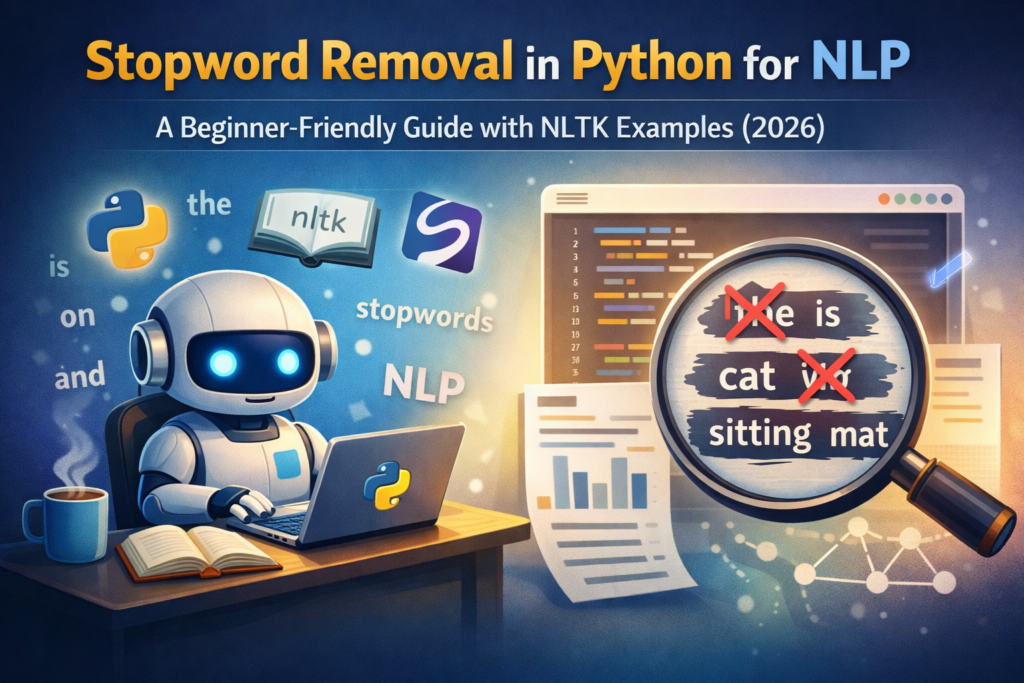
Stopword removal in Python for NLP illustration showing Python, NLTK, and SpaCy processing text and removing common words like ‘the’, ‘is’, and ‘on’ from a sentence.

Stopword Removal in Python for NLP: A Beginner-Friendly Guide with NLTK Examples (2026)

Natural Language Processing (NLP) allows computers to understand and analyze human language. From chatbots and search engines to recommendation systems and sentiment analysis tools, NLP powers many modern AI applications. However, before a machine learning model can process text data effectively, the raw text must go through several text preprocessing steps. One of the most

Stopword Removal in Python for NLP: A Beginner-Friendly Guide with NLTK Examples (2026) Read More »

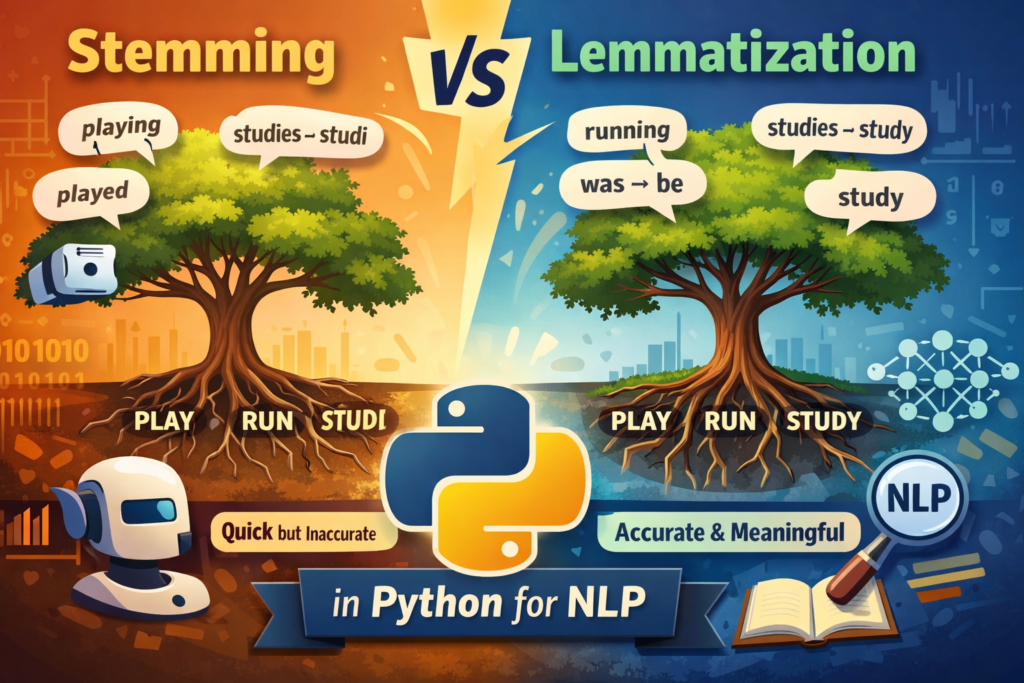
Stemming vs Lemmatization in Python for NLP comparison showing how stemming reduces words to roots like "studies → studi" while lemmatization converts them to dictionary forms like "studies → study".

Stemming vs Lemmatization in Python for NLP: A Beginner-Friendly Guide with Examples (2026)

Natural Language Processing (NLP) is one of the most exciting areas of artificial intelligence. It allows machines to understand, process, and analyze human language. But before a machine learning model can understand text, the text must go through several preprocessing steps. One of the most important preprocessing tasks is text normalization. Words often appear in

Stemming vs Lemmatization in Python for NLP: A Beginner-Friendly Guide with Examples (2026) Read More »

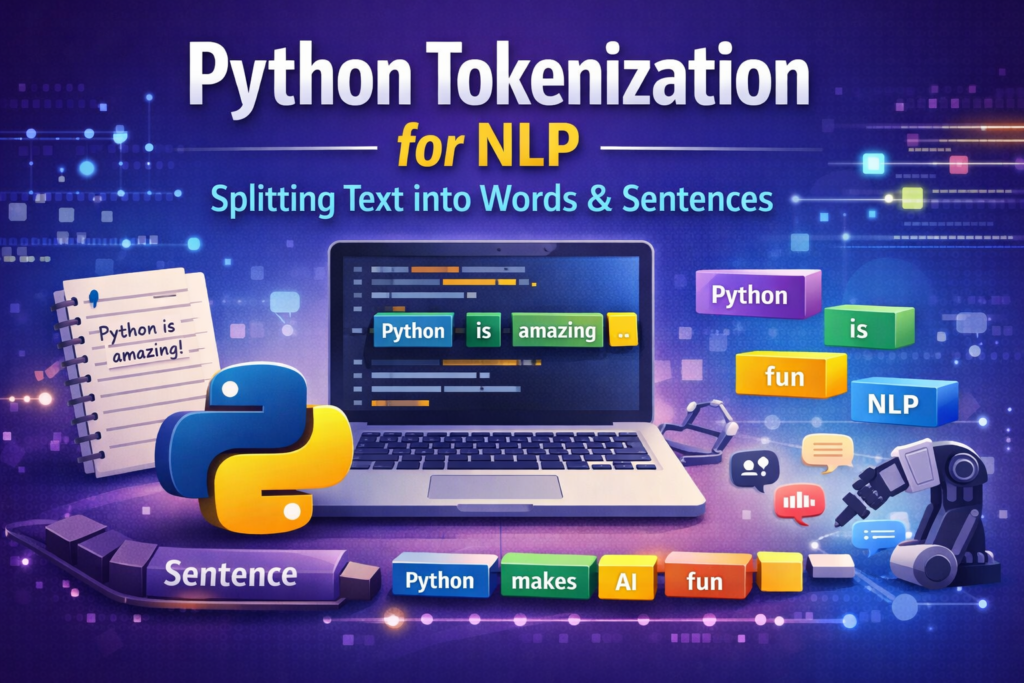
Python tokenization for NLP illustration showing how text is split into words and sentences using Python for natural language processing.

Python Tokenization for NLP: A Beginner’s 5-Step Guide to Splitting Text into Words and Sentences

Introduction From Raw Text to Machine Understanding Human language is rich, flexible, and often messy. We use punctuation, abbreviations, emojis, slang, and many variations of words. Humans understand these patterns naturally, but computers cannot process raw text in the same way. Python tokenization for NLP is one of the most important techniques used to prepare

Python Tokenization for NLP: A Beginner’s 5-Step Guide to Splitting Text into Words and Sentences Read More »

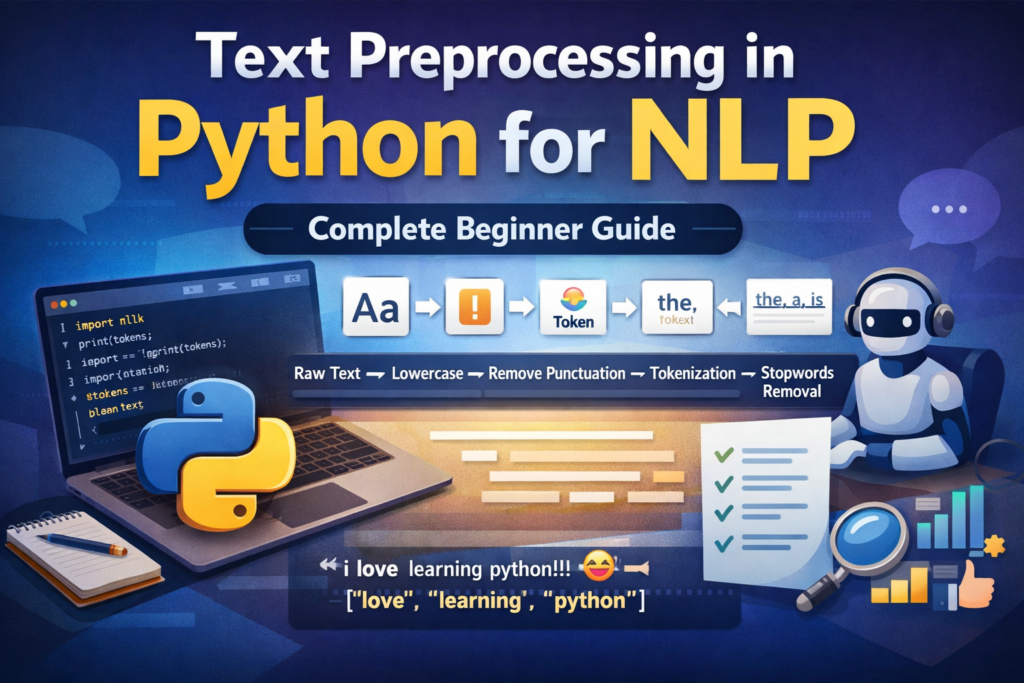
Text preprocessing in Python for NLP pipeline showing tokenization, punctuation removal, and stopwords cleaning

Text Preprocessing in Python for NLP: The Complete Beginner Step-by-Step Guide (2026)

Introduction Natural language processing has become one of the most exciting fields in artificial intelligence. From chatbots and virtual assistants to sentiment analysis and recommendation systems, machines are increasingly expected to understand human language. However, before a machine learning model can analyze text, the text must first be cleaned and structured. Raw text data is

Text Preprocessing in Python for NLP: The Complete Beginner Step-by-Step Guide (2026) Read More »