

Introduction: Why Most Beginners Fail Without a Plan
Python is one of the easiest programming languages to start with — yet thousands of beginners quit within weeks.
Not because Python is hard.
But because they try to learn without structure.
They:
- Jump between random tutorials
- Watch videos without practice
- Study inconsistently
- Never build real projects
The result? Confusion. Frustration. Quitting.
That’s why you need a clear 30-Day Python Study Plan — not random motivation.
In 2026, learning Python is faster than ever if you follow a focused daily system.
This guide gives you:
✅ A structured 30-day roadmap
✅ Clear weekly goals
✅ Daily practice framework
✅ Mini projects for real skill building
✅ A realistic routine you can actually follow
If you commit to this plan for one month, you’ll build strong Python fundamentals and real confidence.
👉 For a bigger picture of your entire journey, follow this complete Python roadmap with projects and AI tools.
Why a 30-Day Python Study Plan Works
A structured study plan removes guesswork.
Instead of asking:
“What should I learn today?”
You already know.
A proper 30-Day Python Study Plan helps you:
- Avoid information overload
- Learn in the correct order
- Practice consistently
- Track progress clearly
- Build momentum
Python itself is simple.
Lack of structure is what makes learning feel hard.
The Psychology Behind a 30-Day Learning System
Most beginners don’t fail because of intelligence.
They fail because of inconsistency.
A 30-Day Python Study Plan works because it leverages three powerful principles:
1️⃣ Momentum Effect
When you study daily, even for one hour, your brain stays in “learning mode.”
Skipping days forces you to restart mentally.
2️⃣ Compounding Skill Growth
Each day builds slightly on the previous one.
By Day 15, concepts feel easier because your brain has adapted.
3️⃣ Reduced Decision Fatigue
If you don’t have a plan, you waste energy asking:
“What should I learn today?”
A structured plan removes that friction.
Discipline is easier when the decision is already made.
This is why 30 days is powerful:
It’s long enough to build skill —
but short enough to stay committed.
Your 30-Day Python Study Plan (Week-by-Week Breakdown)
This beginner-friendly roadmap divides your learning into four focused weeks.
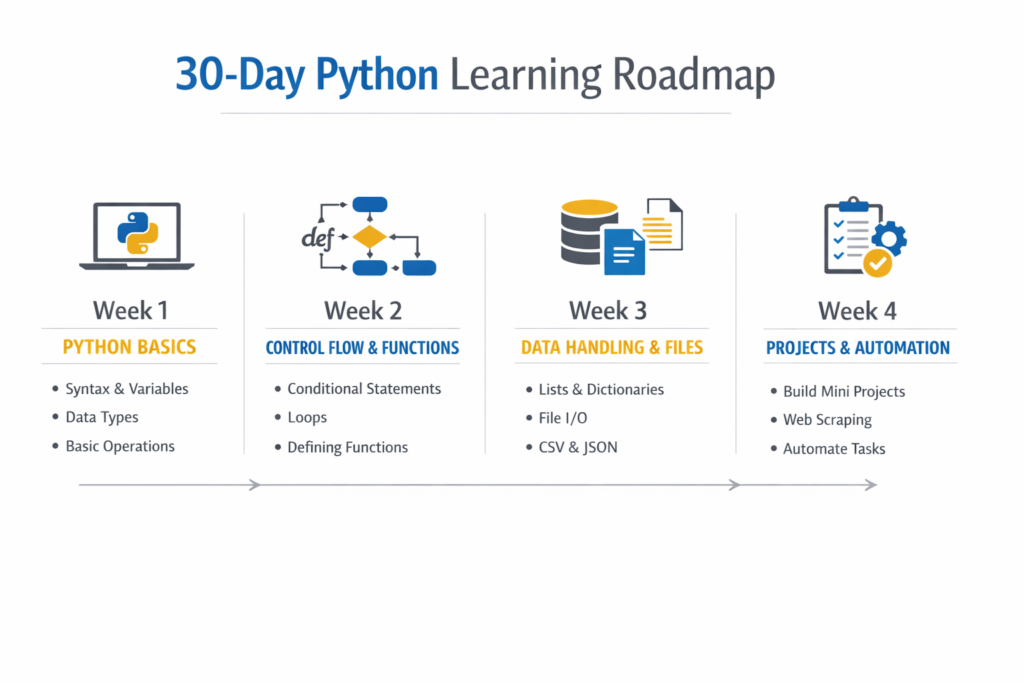
Week 1 (Days 1–7): Python Fundamentals
Focus: Build a Strong Foundation
What You’ll Learn
- Installing Python & choosing an editor
- Variables
- Data types (int, float, string, boolean)
- Input & output
- Basic operators
- Writing simple scripts
Daily Study Structure
- 45–60 minutes learning
- 30 minutes hands-on practice
- Write 1 small script daily
Mini Projects
- Temperature converter
- Simple calculator
- Age checker
👉 Goal: Become comfortable writing basic Python code without copying everything.
👉 To see project ideas you can build during your practice days, check → project ideas you can build during your practice
Week 2 (Days 8–14): Control Flow & Functions
Focus: Make Programs Think
What You’ll Learn
- If/else statements
- For loops & while loops
- Functions
- Basic error handling
Daily Practice
- Write 3–5 small functions daily
- Practice loops with real scenarios
Mini Projects
- Number guessing game
- Password strength checker
- Simple to-do list
👉 Goal: Control how your programs behave logically.
This is where your confidence starts growing fast.
👉 Goal: For detailed Python language reference and examples → Python language reference and examples
Week 3 (Days 15–21): Data Structures & File Handling
Focus: Work With Real Data
What You’ll Learn
- Lists
- Dictionaries
- Sets & tuples
- Reading and writing files
- Working with JSON
- Using built-in modules
Daily Practice
- Solve 5–10 small data problems
- Read/write files daily
Mini Projects
- Contact book
- Expense tracker
- Notes app using file storage
👉 Goal: Handle structured data confidently.
Now you’re no longer just writing scripts — you’re building useful tools.
👉 To combine your routine with a full AI-powered learning roadmap, see → full AI-powered learning roadmap
Week 4 (Days 22–30): Practical Python & Final Project
Focus: Real-World Application
What You’ll Learn
- Basic automation
- Using libraries
- Working with APIs
- Simple data analysis
Daily Practice
- Build one small automation script
- Improve and expand your final project
Final Project Ideas
- Email automation tool
- Folder organizer
- Weather app (API-based)
- Report generator
👉 Goal: Turn knowledge into real applications.
By Day 30, you should have at least 4–6 mini projects and one larger final project.
That changes everything.
Mini Case Study: From Zero to Confident Beginner in 30 Days
Ali (a complete beginner) decided to follow this 30-Day Python Study Plan seriously.
He had:
- No programming background
- A full-time job
- Only 1.5 hours daily
Week 1
He struggled with syntax and basic errors.
Instead of quitting, he rewrote small programs daily.
By Day 7, he could write simple scripts without copying.
Week 2
Loops and functions felt confusing at first.
He forced himself to write 3 small functions every day.
By Day 14, he built a working number guessing game completely on his own.
Confidence started building.
Week 3
Working with files and dictionaries felt more “real.”
He built a small expense tracker that saved data into a file.
For the first time, Python felt practical.
Week 4
He built a simple folder organizer automation script.
It wasn’t perfect.
But it worked.
By Day 30, Ali wasn’t an expert —
but he was no longer a beginner who copied code blindly.
He could:
- Read documentation
- Debug basic errors
- Build small tools independently
That’s the real outcome of a structured 30-Day Python Study Plan.
Not mastery.
Independence.
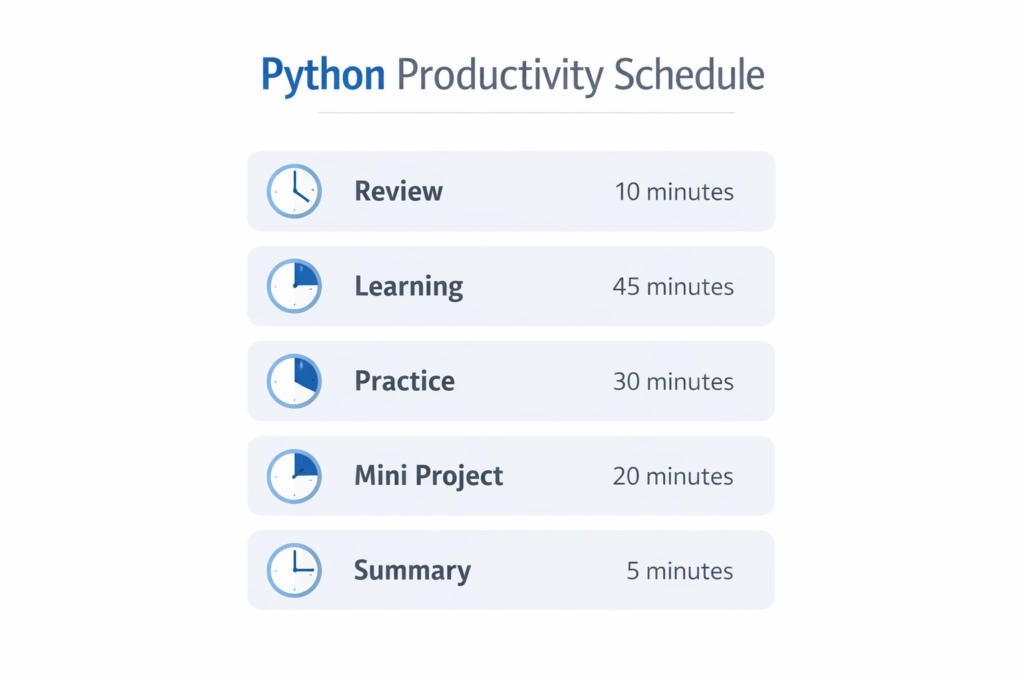
Daily Python Study Template (Use Every Day)
| Time | Activity |
|---|---|
| 10 min | Review yesterday’s code |
| 30–45 min | Learn new concept |
| 30 min | Practice exercises |
| 20 min | Build mini project |
| 5 min | Write summary notes |
This routine keeps learning active and improves long-term memory.
👉 According to research on effective learning methods, spaced repetition improves retention → research on effective learning methods
Smart Tips to Stay Consistent for 30 Days
Consistency is the real challenge — not Python.
Here’s how to survive all 30 days:
✔ Study at the same time daily
✔ Keep sessions short but focused
✔ Practice more than you watch
✔ Track daily progress
✔ Celebrate small wins
Motivation fades.
Systems don’t.
Common Beginner Mistakes This Plan Avoids
❌ Learning randomly
❌ Watching endless tutorials
❌ Avoiding projects
❌ Skipping practice
❌ Studying without clear milestones
A structured 30-Day Python Study Plan eliminates all of these.
How to Measure Your Progress During the 30 Days
A serious learner tracks improvement.
Here’s how to evaluate your progress week by week inside this 30-Day Python Study Plan:
End of Week 1
You should be able to:
- Write simple programs without copying
- Explain variables and data types clearly
- Build small scripts from scratch
End of Week 2
You should:
- Use loops confidently
- Write reusable functions
- Solve small logical problems independently
End of Week 3
You should:
- Work comfortably with lists and dictionaries
- Read and write files
- Build simple data-driven tools
End of Week 4
You should:
- Combine multiple concepts in one project
- Debug basic errors independently
- Build one complete working tool
If you can build something without step-by-step guidance, you are progressing correctly.
Progress in programming is measured by independence — not completion of tutorials.
What You’ll Be Able to Do After 30 Days
If you follow this plan seriously, you’ll be able to:
✅ Write structured Python programs
✅ Build mini projects independently
✅ Understand and debug errors
✅ Work with files and data
✅ Automate simple tasks
✅ Prepare for AI, data science, or web development
You won’t be an expert.
But you will have a strong foundation — and that’s what matters.
👉 For practical examples of how AI helps with code learning and debugging, check → AI helps with code learning and debugging
Is 30 Days Really Enough to Learn Python?
Yes — for fundamentals.
In 30 focused days, you can:
- Understand core syntax
- Write structured programs
- Build small working tools
- Develop logical thinking
But mastery requires continued practice.
The first 30 days build the base.
The next 90 days build real power.
Frequently Asked Questions
1️⃣ Is a 30-Day Python Study Plan realistic for complete beginners?
Yes — if your goal is strong fundamentals, not mastery.
A properly structured 30-Day Python Study Plan focuses on:
Core syntax
Logical thinking
Basic problem-solving
Small practical projects
In 30 consistent days (1–2 hours daily), most beginners can move from zero knowledge to writing structured programs independently.
However, advanced topics like frameworks, data science, or AI require additional months of practice.
The first 30 days build foundation — not expertise.
2️⃣ What makes this 30-Day Python Study Plan more effective than random tutorials?
Random tutorials create passive learning.
This plan forces:
Daily coding
Structured progression
Incremental project building
Practical application
Skill in programming comes from writing code, not watching it.
The reason most beginners fail is not difficulty — it’s lack of structure.
A daily system removes decision fatigue and builds momentum.
3️⃣ How many hours per day are actually required for this plan to work?
Minimum effective dose: 1 focused hour daily.
Optimal: 1.5–2 hours daily.
The key is:
Distraction-free sessions
Active coding
No multitasking
Two deeply focused hours outperform five distracted hours.
Consistency matters more than long sessions.
4️⃣ Can I compress the 30-Day Python Study Plan into 15 days?
Technically yes — practically risky.
If you double study hours to 3–4 hours daily, you can move faster.
But beginners often:
Burn out
Skip practice
Retain less
Programming skill compounds through repetition.
Slower, consistent learning usually produces stronger long-term retention.
5️⃣ What should I do if I get stuck during the 30-day plan?
Getting stuck is normal.
When blocked:
Re-read the concept.
Break the problem into smaller pieces.
Debug line by line.
Search documentation.
Ask targeted questions (not “my code doesn’t work”).
The ability to debug is part of learning.
Struggle is not failure — it is skill formation.
6️⃣ How do I know if I’m progressing correctly?
By Day 30, you should be able to:
Write functions without copying
Build small tools independently
Understand basic errors
Use loops and conditionals naturally
Read simple documentation
If you can build a small automation script without step-by-step guidance, the plan worked.
7️⃣ Should I use AI tools while following this 30-Day Python Study Plan?
Yes — but strategically.
Use AI for:
Debugging explanations
Concept clarification
Code review
Do NOT use AI to:
Generate full projects without understanding
Replace your practice
AI should accelerate understanding, not replace thinking.
Used correctly, it shortens the learning curve significantly.
8️⃣ What comes after completing the 30-Day Python Study Plan?
After the first month, choose a direction:
Automation
Web development
Data analysis
Artificial intelligence
Backend development
The next 60–90 days should focus on:
Larger projects
Specialization
Building a portfolio
The first 30 days build competence.
The next phase builds career direction.
9️⃣ Is this study plan suitable for working professionals?
Yes.
The 30-Day Python Study Plan is designed for:
Students
Freelancers
Working professionals
Career switchers
Because it requires only 1–2 hours daily, it fits realistic schedules.
Progress is about consistency — not full-time study.
🔟 What is the biggest mistake people make while following a 30-day plan?
Quitting around Day 10–14.
That’s when:
Initial excitement fades
Concepts become slightly harder
Self-doubt appears
This is the “discipline zone.”
Those who push past Week 2 usually complete the full 30 days successfully.
The difference between learners and quitters is not intelligence.
It is consistency.
Final Takeaway
Learning Python in 30 days isn’t about rushing.
It’s about:
- Structure
- Daily execution
- Real projects
- Consistency
Follow this 30-Day Python Study Plan seriously — and you’ll be surprised how much progress you can make in just one month.
Now the real question:
Are you going to follow a system…
Or go back to random tutorials?
For a structured overview of everything you need to learn, read this step-by-step Python beginner guide.
If you’re serious about becoming confident in Python and AI, bookmark this guide and follow the full beginner roadmap on CodeHelperAI.

